
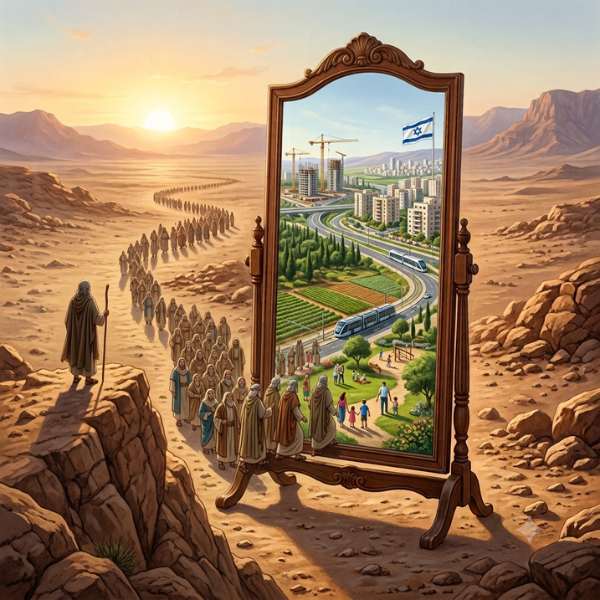
Looking Onward in the Same Direction – Parashat Re'eh | Ran Oron
"See, today I set before you blessing and curse." Moses stands before the people, they are facing the future and he is facing the desert, he will not be entering the promised land. "See today," he tells them. Re'eh, see, in the singular, not "see" in the plural, addressing them as though they were one person, as though speaking to each one individually. Re'eh, as if speaking to himself, knowing that what the heart sees, the eyes do not see. To see the future is to know how to choose. To choose, one must know how to remember, to recall, and to look back. […]

Until the Lord gives your brothers rest, as He has given you – Parashat Devarim | Rakefet Sholder
"Until the Lord gives your brothers rest, as He has given you, and they too take possession of the land… then each of you may return to the inheritance that I have given you." (Deuteronomy 3:20)
The portion of Devarim is always read close to Tisha B'Av. From ancient times until today, this period has been one of national reflection and soul-searching. […]
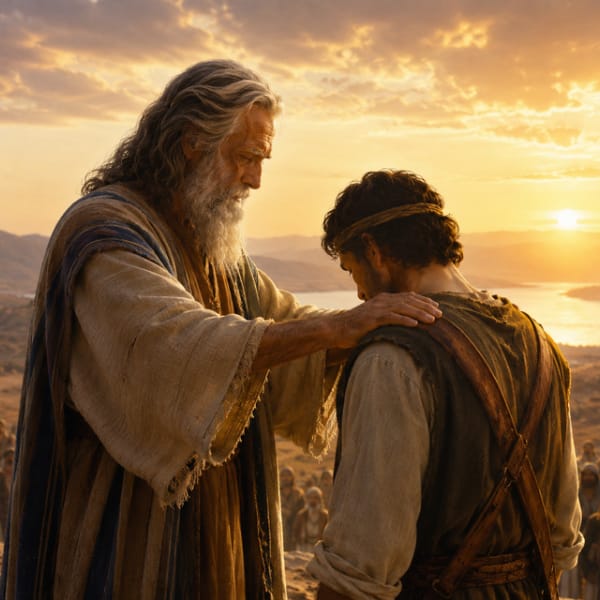
Parashat Pinchas, On the Eve of Elections | Gabi Barzilai
Are we shaping the future, or recycling the past? As elections approach, Parashat Pinchas pushes us to rethink leadership and what real change demands. […]
The Shadow of Everywhere – Parashat Vayikhal | Ran Oron
Seven times Joseph weeps, more than any other person in the Torah. He does not cry when he is thrown into the pit, nor when he is sold to the Ishmaelites. He does not weep when cast into prison, nor when betrayed by his companions there. He does not weep from happiness at his success. Seven times he weeps, but only in his encounters with his brothers, with his father, in the presence of, or facing, his family. […]
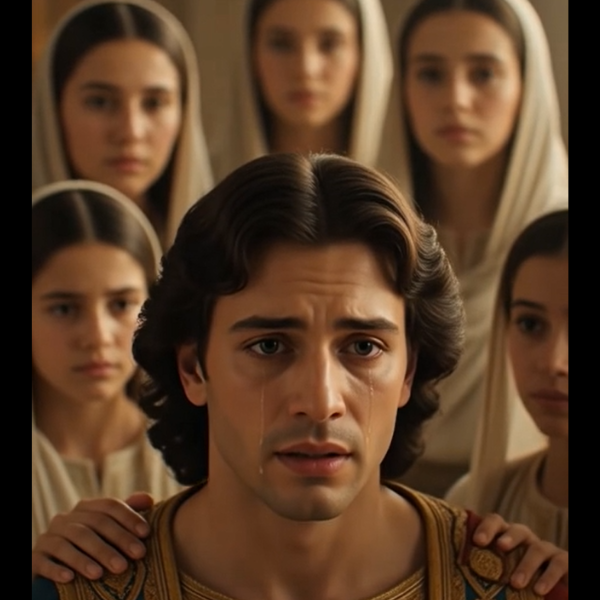
The Storm Touches the Eyelashes – Parashat Miketz | Ran Oron
Seven times Joseph weeps, more than any other person in the Torah. He does not cry when he is thrown into the pit, nor when he is sold to the Ishmaelites. He does not weep when cast into prison, nor when betrayed by his companions there. He does not weep from happiness at his success. Seven times he weeps, but only in his encounters with his brothers, with his father, in the presence of, or facing, his family. […]

Parashat Lech Lecha | Ran Oron
What is the meaning of “Lech Lecha”? Is it the way to fulfill one’s destiny? Is it a call to go to the one place where you truly belong, or to search for the place where you will become who you are meant to be? Is it the path of reason, or perhaps the way of the heart? Or is it the essence of the connection between them? From where does a person draw the strength to set out without asking why, when no clear destination is in sight? […]

A Tale of Two Mountains – Parashat Ki Tavo | Ran Oron
A “chosen nation” not in the sense of being an elevated nation, but because they knew how to realize the right of choice. "The Torah went among all nations", tell us our sages, "it came to Esau and was rejected, to Ishmael and was not accepted, to Ammon and Moab and was refused, until it came to Israel. They said in unison: 'We will obey and listen'". They chose the path of the divine morals […]

In the Place We Are Right – Parashat Korach | Ran Oron
The poetry of the Sons of Korach and Samuel's gentle and wise determination are a testimony to the nature of “the tikun” that takes place after a fall, one that comes in the wake of a bold but failed attempt to change reality. A demand for change in general, and for change in social order in particular, if its source is in pride, excessive self-confidence, jealousy and the sin of arrogance, is doomed to failure. True change originates from a world of doubts, listening and love. “The tikun” will come from a courageous place of regret and taking responsibility, of faith in the power of truth and spiritual heritage. The beauty of the fall is that it is not an end, but a phase, an opportunity and a necessity on the path to inevitable “tikun”. […]

For Whom the Bells Toll – Parashat Tazria-Metzora | Ran Oron
The Torah portions of Tazria and Metzora are read as a single portion in non-leap years and deal mostly with the disease of leprosy. Despite being portions that deal with impurity and illness, Parashat Tazria opens with the purification ritual for a woman who has given birth, an event of renewal and birth. A surprising opening that suggests perhaps within the heart of illness, difficulty, and pain, the key to renewal can also be found. […]

A Nest of My Prayers – Parashat Vayakhel | Ran Oron
Who is “the angel who has redeemed me”? Is it the same angel with whom Jacob wrestled, before earning the name Israel? Did he miss or remember him? How will the angel bless the boys from all evil? And why the Divine Presence does not allow Israel to foresee the future of his loved ones? […]

Parashat Ki Tisa: Leadership, Freedom, and the Golden Calf
Parashat Ki Tisa presents one of the most dramatic moments in the Torah—the sin of the Golden Calf. In this pivotal event, two leaders stand before us—Moses and Aaron—each embodying a different style of leadership, each with a distinct perspective on the relationship between a leader and the people. […]

Parashat Vayechi – Jacob’s New Angel | Ran Oron
Who is “the angel who has redeemed me”? Is it the same angel with whom Jacob wrestled, before earning the name Israel? Did he miss or remember him? How will the angel bless the boys from all evil? And why the Divine Presence does not allow Israel to foresee the future of his loved ones? […]

Like a Flute Accompanying the Singing – Parshat Va’etchanan | Ran Oron
At the beginning of the parasha Moses tells the nation how God refused to hear him. Later he will ask them to hear and listen to him, he will repeat the Ten Commandments to them and remind the people in front of him how their hearts did not have enough faith and love to hear and listen to God. Their disbelief, causing him to be a mediator before God for forty years in the desert, exhausted him. […]

The Garden Was There. Not Eden – Parashat Shelach
Spies or messengers? Full of promise or impending disaster? In this week's parasha, BINA guest writer Ran Oron explores the story of those sent ahead to gather information on the promised land. How do we understand the message of their story in their time and in ours? […]

My Mother Baked the Whole World For Me – Parshat Emor
My parents' house in Omer. Every Shabbat evening my grandmother would light Shabbat candles on the tea cart that stood between the kitchen and the dining room. Perfumed. Her white hair combed back. She brought her palms together, covered her face. Closed her eyes and blessed. The house became silent. Listened. […]

Parshat Shmini -A Silent Minute for the Bird
Parashat Shmini is named after the day on which the dedication of the Tabernacle reached its climax. After a week of precise and detailed preparations, Aaron and his sons bring the divine presence into the Tabernacle. At that height of the moment, a great tragedy occurs. The young priests Nadab and Abihu, the two chosen sons of Aaron the priest, sin in forbidden work and disobey the laws of the sacred service. They are punished for their actions and die. […]

God Is In The Details – Parshat “Tetzaveh”
"Torah shows us that the truth, both the divine and ours, is found in our faith in the power of the connection of opposites." This week's parashah explores the power in the connection of opposites. Ran Oron, reminds us that "In these days of turmoil in our hearts we must insist on the power of connection." […]

Tips for the IDF Reservist After 126 Days at War By Yuval Linden
What a series of intense, wild events! Every time that you think things are calming down and you'll have … […]

And he said to the people, “Be ready for the third day: [the men among] you should not go near a woman.” Exodus 19:15
Ayala Deckel, Head of the BINA Secular Yeshiva, reflects on In this week’s portion, Yitro, we reach a dramatic moment in our formation as a people: receiving the Ten Commandments – the value base of our nation, our moral compass… […]

What We Can Learn From Miriam About Leadership During Times of Crisis
BINA contributor and supporter, Ran Oron, discusses what we can learn about leadership from Miriam during the exodus of Israelites from Egypt in this week's Torah portion. […]
