


Looking Onward in the Same Direction – Parashat Re'eh
In 2008 my three sons studied at The Heschel School, a Jewish day school in New York City. Every year the school celebrated Israel's Independence Day, it did not however mark at all the day which precedes it, Israel’s Memorial Day. I thought it would be right for a Jewish school with such a deep connection to Israel to mark one of the days that are so meaningful to us, the Israelis. I raised the idea with Rivka, who was then running the Hebrew studies program. Together we recalled the ceremonies we had experienced in Israel. She promised to look into it.
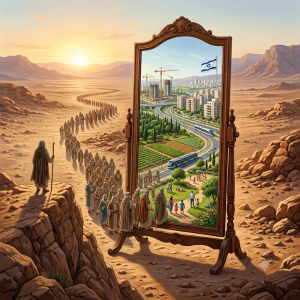
"See, today I set before you blessing and curse" Moses stands before the people, they are facing the future and he is facing the desert, he will not be entering the promised land. "See today," he tells them. Re'eh, see, in the singular, not "see" in the plural, addressing them as though they were one person, as though speaking to each one individually. Re'eh, as if speaking to himself, knowing that what the heart sees, the eyes do not see. To see the future is to know how to choose. To choose, one must know how to remember, to recall, and to look back.
Moses insists. The freedon of choice is the foundation of the life of the nation. In his final days, even though his fate is sealed, freedom of choice is the message, and it is the one he insists upon. Time has no meaning and the future is unknown. Perhaps he recalls his meeting with God when he ascended to receive the tablets of the covenant. God was delayed, The Mishnah in tractate Menachot tells us, drawing crowns, incomprehensible marks, on the letters. Questioned by Moses, God told him about Rabbi Akiva. "Turn back," He said to him, and sent him back to the future. After returning from the future, after not understanding a word of what was taught in Akiva's house of study, and after also witnessing his terrible end, Moses asked God the meaning of His actions. "Be silent," God answered him, "so it arose in My thought."
God's actions, precisely because they cannot be fully fathomed, are the foundation and the basis for the nation and its faith. God's reply and sending Moses back to the future are a testimony to His wish to see His original Torah evolve and develop. Choice, language, and the path of belief change according to time and place. The morality and the freedom of choice embedded within the Torah are its essence and its strength, and they are meant to guide the people to govern and to survive through freedom and respect for every person.
There is always a choice. As the psychologist and Auschwitz survivor Viktor Frankl said, even in the terrible concentration camp there was one freedom the Nazis could not take from their prisoners: the freedom to choose how to respond. Victimhood fixes us in a past we cannot change. Choice fixes us in a future we can and are responsible for changing, it frees us from captivity to our own resentments.
A change Moses knows, does not necessarily mean transformation for its own sake. On the contrary, the relathionship between the two is the key to progress: Fruitful, it brings blessing, continuity, and renewal to each generation anew. Poisonous, it brings curse and repeatedly brings disaster and destruction upon the nation. He reads Yehuda Amichai again and knows that, despite the vague answer he received from God at Mount Sinai, deep within, "the Merciful One desires the heart", the Merciful One asks first and foremost for a person's sincerity, honesty, and devotion. He asks him to choose. “My father was god yet he did no know.” Writes Amichai, He gave me / the ten commenments without a thunder, without rage, not in a fire and not in a cloud / but with gentelness and love.” And continues: “My father’s voice was white like the hair on his head. / Then he turned his face towards me for the last time / like in the day he died in my arms and said: let me add two to the ten comenments: / The eleventh one, “ do not change” / The twelfth one, “change now, change later. / Said my father, turned away from me and walked away / disappearing in his strange distances.”
The people look at the face of their aged leader. Behind his back, awaits them the promised land. Soon he will leave them and ascend to meet God once again in an unknown place on Nebo. Eye sight is deceptive. A person sees only what is in front of him at the present time. True vision, that of the heart, is the courage to choose at every given moment, again and again. To accept, to learn, and to remember the fragments of the broken past; to change in order to mend, to connect, and to build; to create and to forge a future, to advance and bless the face of progress.
"Life taught us,"writes Antoine de Saint-Exupéry in his book Wind, Sand and Stars (written just before The Little Prince), "that love does not consist in gazing at each other, but in looking onward together in the same direction." Choosing an open heart is the way, and it is this that will lead the people to the safe harbor of forgiveness and to a better future.
A year passed. In 2009 I was invited to The Heschel School on Memorial Day for Fallen IDF Soldiers, for the ceremony of lowering the flag to half-mast. Over the years, the ceremony, and with it, Memorial Day, became part of the curriculum. Every year since, the fifth-grade students study one of the Israeli mourning songs, translate it into English, and sings it in both languages, English and Hebrew, before the entire student body.
Written by Ran Oron is an Israeli architect who has lived in NY for over 20 years.
