


The Shadow of Everywhere – Parashat Vayikhal
Again, war. A great shadow has fallen upon the land. A long shadow, crossing seas, touching. It feels strange to write from here. Strange to write from afar and now about a Tabernacle , about a child who builds, about art and about light. …And yet perhaps not… Perhaps now, of all times, is when one must repeat and remember, the source of every shadow, the end of every darkness, is light.
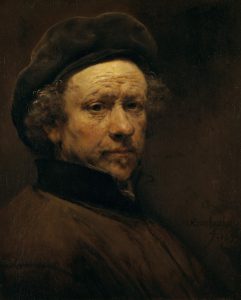
When I lived in London, Rabbi Kook recounts, I would often visit the National Gallery. My favorite paintings were those of Rembrandt. In my view, Rembrandt was a tzaddik, a righteous man. When I first saw Rembrandt’s paintings they reminded me of a saying of the Sages about the creation of light. When God created light, it was so powerful and radiant that one could see from one end of the world to the other. But God feared that the wicked might use it. What did He do? He concealed that light and reserved it for the righteous in the world to come. From time to time there are great individuals whom God blesses with the vision of that hidden light. I believe that one of them was Rembrandt, and that the light in his paintings is the very light God created in the days of Genesis.
Moses is weary. The sin of the Golden Calf committed by the people he left at the foot of Mount Sinai is painful and frustrating. Now, after receiving the Torah and descending from the mountain, he is commanded to build a Tabernacle, a house for God that will show the doubtful people their way. He chooses Bezalel to build it with him. The young builder, true to his name, is Be-tzel El — in the shadow of God. The divine design is entrusted in his gifted young hands.
Bezalel is a descendant of Miriam the prophetess, Moses’s sister, and Caleb son of Jephunneh, the righteous spy. He is the grandson of Hur, who lost his life when he opposed the making of the Golden Calf. At the age of thirteen he is entrusted with the task of building the Tabernacle. The old leader chose well. “It took me four years to learn to paint like Raphael,” Picasso once said, “but a lifetime to learn to paint like a child.” The building of the dwelling house for the divine light can only be carried out by a pure soul, unburdened, uncorrupted – an artist. The meticulous work of construction requires a different vantage point: new and fresh, one that approaches the task with innocent love. This is the only way to build a home of light.

“Light is looking for a wall to be seen” the architect will teach him, matter creates space and gives life to light. The play of light and shadow upon matter is an act of creation. In his enthusiasm, the Talmud tells, the young architect does not hesitate to argue with the old leader: “It is the way of the world that a person first builds a house and only afterwards brings the furnishings into it. Yet you say: make the Ark, the vessels, and the Tabernacle! The vessels that I make ,where will I place them?” In his opinion the order of building must be reversed: first the walls, the framework of the sacred space, and only then the vessels, the Ark and the cherubim. The walls of the Tabernacle will become a kind of a “good fence”, a place of gathering and intimacy between the people and the divine neighbor who seeks to dwell among them. It is a temporary structure, one that constantly dismantles and rebuilds. One that resides in their hearts and shows them the way. The secrets of its craft and its details are known and built by a child.
In the shadow of God, the young one knows how “to combine the letters by which heaven and earth were created.” The wisdom, understanding, and knowledge attributed to him are those spoken of in the Book of Proverbs: “Through wisdom God founded the earth; by understanding He established the heavens; by His knowledge the depths were split apart.” The process of building the Tabernacle mirrors the process of the creation of the world and begins with the concealment of light. The shadow, the dimmed divine light, is constructed with innocence, talent, and love by a soul that carries within it the seeds of prophecy and faith in the righteousness of the path.
The Tabernacle, the divine house, is like a human being; it is dismantled and rebuilt along the journey, with the heart at its center. It is the cloud that shows the way, and at the same time a place of mist and uncertainty. The wall that casts its shadow is the outline of the Tabernacle’s face and at the same time the entrance to its interior. It is not a dividing wall but a connecting one. God’s choice to reduce (letzamtzem) his presence into his Tabernacle, to live within the people’s heart, to be built and dismantled and to travel with them wherever they go, grants the people, as it does a human being, a space to grow. Their identity. The house of the concealed divine light, God’s gift to humanity, is entrusted to the hands of a child. A child who is the shadow of God and a window into his soul.
On one of the walls in my kitchen hangs a board. On it are postcards;
Rembrandt’s self-portrait as an old man
one of The Little Prince
a postcard of the Angelus Novus, and one of An Angel Serving Breakfast.
There is also a photograph of my three sons from sixteen years ago
and magnetic letters, א. ר. צ. punctuated in segol.
Written by Ran Oron is an Israeli architect who has lived in NY for over 20 years.
