


Parashat Lech Lecha
I was twenty-five years old when I left Israel,my homeland, a career in the Air Force, friends, and family, and set out for America to study. I sought to fulfill my childhood dream of becoming an architect. I could not have imagined then that thirty-five years later I would raise three sons here and call this place home.
In 2013, I designed the lobby of the Abraham Joshua Heschel School in New York City. The lobby was not conceived as a temporary passageway, but as a place of encounter and connection, a space for children and adults where spontaneous, informal activities would become an inseparable part of the learning process. A place for forming a community.
The southern wall of the generous space was designed as a map based on the phrase “Lech Lecha”, “Go forth”, in which God commands Abraham to leave his home in Haran, to go to the land of Canaan, and to found a nation. This seemingly simple phrase in essence asks a person to go toward himself. When joined the two identical Hebrew words connect a vast journey that reaches outward, to distant, unknown horizons, to a personal inward journey to hidden realms of the self and consciousness.
What is the meaning of “Lech Lecha”? Is it the way to fulfill one’s destiny? Is it a call to go to the one place where you truly belong, or to search for the place where you will become who you are meant to be? Is it the path of reason, or perhaps the way of the heart? Or is it the essence of the connection between them? From where does a person draw the strength to set out without asking why, when no clear destination is in sight? What is clear is that this divine command, this call to embark on a journey toward the self, demands separation from one’s previous life.That separation is threefold: from one’s land, from one’s birthplace, and from one’s father’s house. The complexity, depth, and scale of this parting intensify step by step—so too the confusion, the pain, and the fear of losing what is safe, familiar, and close.

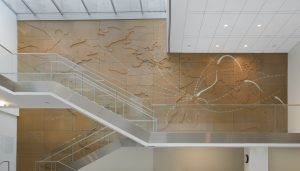
“Lech Lecha”, the relief wall at the school’s entrance, depicts on two intertwined scales the wanderings of the people of Israel from Abraham’s journey to our own day. One map, that of ancient times, traces the journeys from Abraham to the destruction of the Second Temple in 70 CE and the exile that followed. These journeys are marked with azure lines. The second map, from 70 CE to the present, is a world map describing the waves of Jewish migration over the past two thousand years. Journeys toward the Land of Cnaan, the Promised Land, are shown as continuous lines; journeys away from it, exiles by choice or expulsions by force, are drawn as dashed, broken lines.
Sweeping and etched across the intertwined maps, the azurw and blue lines bear witness to the life of a nation. The map is a constant reminder of the meanings and complexities of the idea of a “journey” and of the concept of the “Promised Land”,both in the life of a nation and in the life of an individual. “Lech Lecha” is an ongoing road map, generous yet painful, a portrait of a history of desire and survival, of triumphs and catastrophes, of nightmares and dreams. A master plan tracing the high tide and low tide of faith. Lines of longings through which every new generation rediscovers itself and joins the great eternal voyage in its own way.
Sevral years later, I was asked to speak about “Lech Lecha” to the fourth-grade class. In preparation for the visit, I gave each child a drawn blank world map and asked them, together with their parents and grandparents, to draw their own family journey. On the appointed day, we stood on the opposite side of the lobby facing the wall. I brought a laser pointer and asked who would like to show their family’s journey on the great “Lech Lecha” map.
Everyone did. One by one, they stood before the eternal wall of journeys and moved a point upon it.
Written by Ran Oron is an Israeli architect who has lived in NY for over 20 years.
