


Weekly Torah Portion – Sukkot, September 2026
“You shall live in booths (sukkah) for seven days… so that your generations may know that I made the Israelites live in booths.”
— Leviticus 23:42–43
During Sukkot, we leave the familiar and permanent home and enter the sukkah- a temporary and simple dwelling. This unique transition invites us to ask a fundamental question about our lives: What actually turns a place, even a temporary one, into a home? Is it the walls, the furniture, the thatched roof, the decorations?
“The LORD appeared to him by the terebinths of Mamre… He lifted his eyes and saw three men standing near him, and when he saw them, he ran from the entrance of the tent to greet them.”
— Genesis 18:1–2
In Parashat Vayera, Abraham is sitting at the entrance of his tent. The moment he notices three men approaching, he interrupts his conversation with God and goes out to greet them.
Abraham does not simply open the flap of his tent. He goes out to meet them and invites them inside. Suddenly, his tent becomes full. This fullness- the presence and closeness of other people- transforms the tent from a merely functional place of residence into a space for human connection.
This motif continues throughout the passage. The news that the three guests bring Abraham is not a promise of wealth, possessions, or status. They tell him that his tent, his home, will continue to be filled- this time with the laughter of a child, with family, and with continuity. This is the wealth the angels announce to him, a different kind of privilege granted to Abraham: not how many people are in his home, but who is in it.
For, as the Talmud teaches:
“Hospitality to guests is greater than receiving the Divine Presence.”
— Shabbat 127a
Once we have opened our home, we take it one step further: hospitality should be offered with joy.

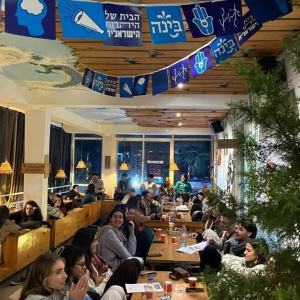
“And you shall rejoice in your festival… you, your son and your daughter… and the Levite, the stranger, the orphan, and the widow who are within your settlements.”
— Deuteronomy 16:14
Here too, the Torah emphasizes that joy is not solely a private or family affair. It should include our immediate family, our friends, and, together with them, those who are different or vulnerable: the stranger, the orphan, and the widow.
Hospitality is the ability to see the person standing beyond the door, to make room for them, and to transform them from a stranger into a guest, and from a guest into part of the home. The joy of the holiday grows when it is shared.
The sukkah, by its very temporary and open nature, reminds us that our home is not merely the place we return to at the end of the day. It is also the place we choose to open to others- to family and friends, but also to those who are different from us, to those who may not have a home of their own, and to those who may find themselves on the margins of society.
The tradition of the ushpizin invites us to welcome guests into the sukkah. The seven traditional ushpizin represent central figures in Jewish history: Abraham, Isaac, Jacob, Moses, Aaron, Joseph, and David. (Why the central women of Jewish history are absent from this tradition is a subject for another article.)
But we can- and should- see this tradition as a broader invitation: to think about whom we welcome into our homes, our sukkah, and our lives; whom we make room for; and who may be waiting for someone to open the door for them.
This year, we are sending you two invitations.
The first is to open your home and your heart to another.
The second is to be an ushpizin yourselves- to join the sukkot of BINA and BINA’s community spaces in cities, moshavim, and kibbutzim throughout Israel, as well as at BINA communities in East Asia and South America.
We wish all of us a holiday in which we are able to open our homes and our sukkot to others, to see those who are standing beyond the door, and to create within ourselves a space for encounter, conversation, and shared joy.
Chag Sukkot Sameach,
May we all have the privilege of being ushpizin- and of welcoming ushpizin- into the homes of friends and loved ones.
Written by Rakefet Sholder, Director of External Relations at BINA.
