


Parashat Chayei Sarah – Between Vision and Action
Parashat Chayei Sarah brings us face to face with Abraham at a difficult moment. Sarah has died, and Abraham seeks a place to bury her. He approaches the Hittites, the local inhabitants of the land, and asks to purchase a burial plot from them:
“I am a stranger and a resident among you. Let me purchase a burial site among you, so that I may bury my dead.” (Genesis 23:4)
There is something surprising about this request. After all, Abraham came to the land in response to a divine command and had already received an explicit promise: “To your offspring I will give this land” (Genesis 12:7). From Abraham’s perspective, this land is part of the destiny of both himself and his descendants. And yet, when he first seeks to acquire property there, he does not claim it by virtue of that promise. Instead, he presents himself as a stranger and a resident, acknowledges the Hittites’ ownership of the land, and asks to purchase a plot of ground from them.
The Hittites honor Abraham, calling him “a prince of God,” and offer him the choice of their finest burial sites. Ephron the Hittite, the owner of the cave Abraham wishes to purchase, even offers him the field as a gift. But Abraham insists on paying. He negotiates the price, weighs out the silver in the presence of the Hittites, and only then does the Cave of Machpelah become his family’s burial place.

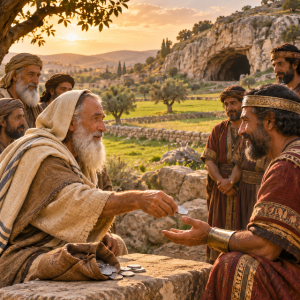
We can read this story as a straightforward real estate transaction, intended to secure Abraham legal ownership of a burial site. But we can also read it as a story about the relationship between vision and its realization.
Abraham has a grand vision. He believes that the land has been promised to him and that he is destined to become the father of a great nation. But this belief does not eliminate the need to act within the realities of human society. Before him stand other people, with their own rights, desires, and interests. To bring his vision to life, Abraham cannot rely solely on his own sense of righteousness. He must build relationships with them.
This week, in the aftermath of the elections, Israeli society once again finds itself at a point where competing visions seek to become reality. Each camp believes in the righteousness of its path, and each seeks to shape the country's future according to its own values and beliefs. The elections determine who will be entrusted with the authority to lead, but they do not determine what kind of society will emerge along the way.
And that is no less important a question.
We are accustomed to thinking of a vision as the goal and the path as merely the means of achieving it. But the means we choose do not disappear once the goal has been reached. They shape our relationships, our norms, and the culture in which we will live. A society built through the exercise of power and coercion, even in the name of a worthy vision, may discover that those very practices have become part of its character.
Abraham does not abandon the promise made to him. He begins to bring it to fruition. But the way he goes about it teaches us that realizing a vision is not simply a matter of reaching the destination. It is also about the kind of reality we create along the way.
Because ultimately, the way we seek to build our model society is already part of the society we are building.
Shabbat Shalom
Written by Yaakov Shapir, Director of Beit BINA Pardes Hanna-Karkur
