


An American in Israel at War – An Interview with BINA MITF Program Participant Jeremy Brian Randall
MY: Hi Jeremy, could you tell us a bit about yourself and how you ended up here in Israel with MITF?
JR: Hi and sure. I’m glad to still be here in Israel, with everything that is going on. I’m from the USA, from Georgia, and I lived in Augusta before moving here for the year to experience Israel in BINA’s MITF (MASA ISrael Teaching Fellows) program. I arrived at the end of August.
I decided to come to Israel for very personal reasons. I grew up in a family with a mix of religious practices – Christian, Catholic and Jewish. I’m 30 years old now and about 5 or 6 years ago my aunt shared with me some of the family genealogy and research she had been working on. As I learned more about the Jewish parts of my family I became curious and wanted to explore more. I started going to synagogue and at one point a Rabbi I knew suggested that I might find it a worthwhile experience to spend time in Israel and immerse myself in the culture and in vibrant Jewish life. Right after that conversation I saw something on Facebook about MITF and here I am.
MY: Coming to Israel and particularly to participate in MITF, what were some of your plans and expectations for the year?
JR: In general I wanted to see what it feels like to be part of a community that is so Jewishly alive. I wanted more international experience – I had traveled in Asia and Europe and I wanted to be abroad and feel a bit more settled in a place, able to make an impact. BINA’s MITF program bases us in Tel Aviv for 5 months and in Beit Shean for 5 months so I felt that I’d have the chance to get to know two cities and do meaningful work teaching English in elementary schools.
MY: How has the past month been for you? Did you consider returning to the States?
JR: I don’t want to leave. After the horrible things that happened on Oct 7th my reaction was that I just got here and I'm here for a reason. I want to see that through. Before I arrived in Israel I had been traveling a lot. I have been a tourist and seen so much. I’m ready now to stay and fulfill my mission here. That doesn’t mean it has been easy. I’m dealing with a lot of steady stress and anxiety. But I’m reaching out and finding support and help. We’re all of us pushing things aside and doing our work and I’m trying to process it as I go. My family and friends are worried and ask sometimes if I want to come home but so far they are supportive of my decision to stay.
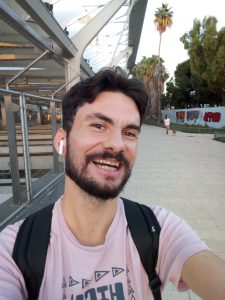
MY: How has work been for you since you arrived and in the last month?
JR: Most of all, I feel like I’m making a real impact here. I’m teaching English at Keshet Elementary School in south Tel Aviv. Many of the students in the school are from families who are asylum seekers here in Israel. My students come from so many different cultures and religions.
I’m teaching students in 4th, 5th and 6th grades. We’re working on English and I’m learning bits of the languages they speak. We are doing a mix of zoom and in-person, because the school has to be careful not to have more students on premises than they have space for in their shelters so each day some students and staff are on zoom and others are in person.
Our school is also physically hosting another school whose building doesn't have a shelter so we are serving a larger number of students than usual.
MY: It’s a very unique perspective, getting to be here in Israel during this time. What do you want someone who isn’t in Israel to know?
JR: Being in Israel at all right now is definitely a unique experience and I think teaching in the school and community where I am is an especially unique perspective. Most of my students and their families aren’t originally from Israel. They came from other places and they want this country to thrive. Seeing their support is really moving. I want people to know how diverse Israel is. That there are muslims and Arabs living here in Israel who want Israel to be strong, who want to live in the open and tolerant society they have experienced here.
I’m also glad I’m here because while the news shows the ugly side of what is happening, being here in Israel you also get to see and experience first hand the other side. That even now with so much division, there are moments of beauty and hope and I believe that as humans we really are more beautiful than what we are doing at the moment. We have so much potential and we can do better than what we are doing now. None of it has to be this way and we can create a different reality.
Marcie Yoselevsky is a member of BINA’s External Relations team. Marcie moved to Israel three years ago. She has found and made her home in Tel Aviv. Marcie grew up in New London, Connecticut, and lived for many years in New York City, working in the Jewish and modern dance communities.
