


The Storm Touches the Eyelashes – Parashat Miketz
My final thesis at the Cooper Union School of Architecture in New York was Chelem,the city of dreamers. I imagined it on the tongue of the Dead Sea, the lowest city in the world, and designed it as building blocks for my first son, who was just born,. In 2013, eighteen years later, we celebrated my second son’s Bar Mitzvah in a synagogue I designed. The design was based on Chelem and on Avot Yeshurun’s poem “All the Rivers”, a poem about longing. On the eve of the event I showed the space to my father, who arrived from Israel. I was moved to be with him in a place that had taken me years to reach. We parted; he returned to my apartment. I stayed by myself on the bank of the Hudson and burst into tears.
Twenty-two years have passed. Joseph meets his brothers.
“And he turned away from them and wept…” the text tells us.
His brothers stood before him. They did not recognize him, dressed in royal garments.
He recognized them but made himself a stranger. Aloof. He relied on his clothing to hide who he was. Relied on his garments as his father had when he stole the birthright. Relied as his brothers did, when they lied after throwing him into the pit, staining his ornamented tunic with blood.
Relied as Potiphar’s wife did, who slandered him and remained with his garment in her hand.
He trusted his power. A ruler, proud, confident.
They bowed to him. He remembered the dream of the sheaves, the dream of the sun, the moon and the bowing stars, he had waited and hoped for this moment for years. He looked at them pleading before him. He, the crafty one, who had masterminded everything, then he suddenly fled. Escaped to the other room so that they would not see his tears.
Seven times Joseph weeps, more than any other person in the Torah. He does not cry when he is thrown into the pit, nor when he is sold to the Ishmaelites. He does not weep when cast into prison, nor when betrayed by his companions there. He does not weep from happiness at his success. Seven times he weeps, but only in his encounters with his brothers, with his father, in the presence of, or facing, his family.

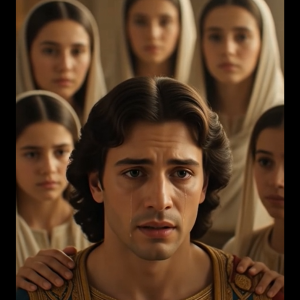
His first cry is in secret. In a side chamber.“ דמעה דלא שלטא בה עינא” (A tear that the eye does not rule over), the Zohar calls it. A hidden tear is a tear which the eye has no control. It is the cry of a person who can no longer remain in the same room with his forgotten identity and the truth awakening inside him. Joseph’s first tears do not come from distress, pain, or from triumph or joy. They are uncontrollable tears flowing from the deep, innocent, pure place of a child. The cry of a dreaming son and a longing brother.
“במסתרים תבכה נפשי” (In secret my soul shall weep) God whispers to Himself. The sack of tears mentioned in Psalms — “שִׂימָהּ דִּמְעָתִי בְּנֹאדְךָ” (Put my tears in Your flask) is inside every human being, and inside the Great Father as well. In His forced loneliness, He too longs to be a child once more.
In the storm rising within him, Joseph escapes to a room.“The stormy today is incredibly stormy” the poet will murmur to him from the drakness,“and the past today is the very past and there is a slight future, and there is no present in the air”. There, he will discover that the streagth of a tear. From it begins foregiveness, and with it he will set out on the path of pardon. “The storm touches the eyelashes and each moment shatters into shards,” she will soothe him gently, reminding him in the darkness, that the Egyptian prince was always Joseph, and that he is not, צָפְנַת תַּעְנַךְ (Zaphenath-Paneah), the name that Pharaoh gave him. In the silent eye of the storm the “tikkun” will begin, and through it, he will reconnect to himself, to his father, and to his brothers.
“And I stretched my sleepy hand to touch his face, a little below his forehead, high, and suddenly, instead of his spectacles, my fingers touchedt tears. Not once in my life, not before that night nor after it, not even at my mother’s death, did I ever see my father cry” Amos Oz describes his childhood experience on the night of the declaration of the state of Israel. “And in truth, even that night I did not see: the room was dark. Only a hand, Only my left hand saw.” he remembers.
A tear comes from the heart, it is stronger than a prayer. It is the connection to one’s deepest and truest identity, a silent testimony, recurring and surprising, to the low and high tides of a person’s life. It is the river of longings and dreams where words no longer exist, and only the memory of the inner childhood compass remains. The tears will show him the way, time after time, from generation to generation, toward the reunion of a family and the rebuilding of inner peace and of his home.
A generation has passed. My eldest son is now thirty. A few weeks ago, his brother officiated his marriage to the woman he loves, in a clear voice asked him to break the glass. In front of them sat the family that came from Israel, his grandparents too. Behind them, quietly flowed the Hudson River.
Written by Ran Oron is an Israeli architect who has lived in NY for over 20 years.
