


Entrance Gate to the People – Israeli Conversion
“They are aware that this national movement contains far more than diplomacy and assemblies alone… Being for the most part filled with the spirit of Judaism from their youth, they feel within themselves that this spirit is still alive and present in their hearts and reflected in their lives, even though their religious outlooks have greatly changed. From this they draw the necessary conclusion that there is indeed a national spirit to Israel that is not confined to religious belief alone.”
(Ahad Ha’am (Asher Ginzburg), “National Morality”, 1898)
At the end of the nineteenth century, as many European nations underwent processes of national revival, Jews too were compelled to re-examine the essence of their collective identity. This awakening was not only a response to persecution and exclusion, but a deeper search for a renewed identity, one that would integrate an ancient heritage with the modern needs of a community redefining itself.
One of the most influential thinkers in this intellectual discourse was Asher Ginzburg, known as Ahad Ha’am. In 1898, a year after the First Zionist Congress, he published his essay National Morality. Witnessing the processes of secularization and the encounter with modernity that swept through European Jewry, Ahad Ha’am proposed a revolutionary distinction: there exists a “national spirit of Israel that is not confined to religious belief alone.” In other words, Judaism is not only a religion, but a living and evolving culture that contains values, traditions, and ways of life that extend beyond a narrow religious framework.
The great debate of the period revolved around the question: how should Jewish national revival begin? In contrast to Herzl’s political Zionism, which sought an immediate solution to the Jewish condition through the establishment of a state, Ahad Ha’am advanced the idea of spiritual Zionism. In his view, national revival should begin with the creation of a spiritual and cultural center in the Land of Israel, one that would renew Jewish culture and serve as a source of inspiration for world Jewry. For Ahad Ha’am, the focus should not be on the “Jewish problem,” but on the “problem of Judaism”: what Judaism should be in the modern era, and how it can continue to serve as the spirit of the Jewish people when much of it no longer adheres to traditional religious belief.
For Ahad Ha’am, the establishment of a physical refuge for Jews from persecution or death was not sufficient. And it is not sufficient for me either.
It is strange to write these lines while again serving in reserve duty in defense of the State of Israel. Like hundreds of thousands of others, I have been called to serve and have answered that call to protect the basic right “to be a free people in our land,” as expressed in our national anthem. I do not deny the need to defend our physical existence from external threats. Yet even in times of war, I find myself drawn to Ahad Ha’am’s claim that physical security is only a precondition, not the goal. The goal is a spiritual national existence.
Today, the problem of the Jewish people is not only physical but also spiritual. While we fight for our material survival, we must also envision the spiritual future of our collective identity. The central question before us is: what kind of Jewish-Israeli state do we seek to build, and how can we integrate the Jewish dimension into public life without imposing it on the individual?

A New Paradigm – Judaism and State
In Israeli public discourse, there is a tendency to frame the issue as “religion and state.” This framing entrenches a false dichotomy between “religion,” identified with Orthodox rabbinic authority, and “state,” identified with secular universalism. I propose setting aside this framework and shifting instead to a discussion of “Judaism and state.”
I could easily write thousands of words about the ways Orthodox rabbinic institutions alienate Israelis from Judaism – stories of coercion in marriage, conversion, and burial practices are not rare. As someone from a traditional-Conservative family, I have been exposed to these experiences all my life, and they burn within me. But here I set myself a different challenge: not to write about what must be dismantled, but to imagine what might replace it.
I am not an advocate of a strict separation of religion and state aimed at creating a universal civic identity devoid of Jewish content. I know there are those who desire such a vision for Israel. For myself and my family, I seek something different: a rich and meaningful Jewish-Israeli identity. I believe I am not alone in this. Most Israelis do not desire a purely universal civic identity. The question, then, is how to build a framework that enables a Jewish-Israeli state while preserving diversity and individual freedom in a modern democratic society.
The relationship between Judaism and state in the Israel of the future I imagine is based on a positive approach, one that does not ignore religious life, but recognizes it as one authentic expression of Jewish existence, neither superior nor inferior to other ways of living a full Jewish life. Religious institutions in all their forms will continue to exist in Israel of 2048, but when we speak of the state itself, of the collective framework, we will speak of Judaism, not Jewish religion.
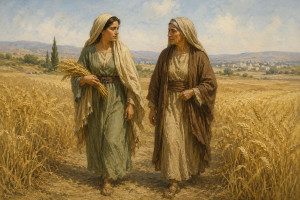
Vision of Israel 2048: Israeli Conversion – “Wherever you go, I will go; wherever you dwell, I will dwell; your people shall be my people, and your God my God.”
Israeli Conversion as a Gateway
Why conversion?
I myself did not undergo conversion, nor did my parents or grandparents. I do not speak from personal experience of conversion, but from my work as an educator guiding young men and women in a pre-military gap-year within BINA. Over the years, many young people passed through my guidance – young Israelis born, raised, and educated as Jews, even though they are not Jewish according to halakha. Most were children of immigrants from the former Soviet Union.
In the transition to military service, they encountered a different reality. Judaism in the IDF of the early 21st century is still largely shaped by Orthodox-national frameworks, whose approach to conversion differs fundamentally from my own. They were invited to participate in the “Nativ” program, and many did so, whether or not they ultimately chose to undergo Orthodox conversion.
I vividly remember one graduate who chose to convert but was deeply disappointed when she failed before the rabbinical court. We sat with her, the academy director and I, trying to support her. She had been one of the most engaged students, immersing herself in Talmudic stories, enjoying modern interpretations of Tanakh, and singing enthusiastically in our classes. How could she be considered “not Jewish enough”?
“We want to clarify,” I told her, “that for us you are Jewish. But since you entered this process, you should understand what they are looking for. They are not looking for cultural engagement or identity. They are asking about Orthodox halakhic observance: Shabbat laws, ritual immersion, and so on. If this is what you want, we will support you, but this is the framework you are entering.”
I could not shake the feeling that we are leaving the gates of the Jewish people in the hands of a single stream among many.
If this is our present , where are we heading?
Imagine with me: The Law of Return remains in force in 2048. Anyone with Jewish ancestry continues to be eligible for Israeli citizenship. Those who do not qualify may choose to enter a conversion track to join the Jewish people.
Alongside existing denominational conversion systems, a new framework will emerge: Israeli Conversion – an accessible, state-based process inspired by tradition but conducted in a civic framework. It will emphasize Jewish-Israeli culture, shared destiny, and participation in the Zionist project.
This will not be a fast-track process, nor is it intended to encourage mass conversion. It will include study of Jewish history, Hebrew culture, Jewish texts, and lived cultural experience: museum visits, theatre, music, encounters with thinkers and communities, and engagement with diverse expressions of Jewish life.
Upon completion, candidates will undergo evaluation by a professional and cultural committee and, after a concluding journey through Israel and Jewish heritage sites, will receive formal recognition as members of the Jewish people and Israeli citizens.
National Morality as a Way of Life
This vision rests on Ahad Ha’am’s central insight: Judaism is not merely a system of beliefs, but a way of life that encompasses all aspects of human existence. As he wrote, it must guide even the “ordinary private individual,” becoming a measure for all actions, so that national identity is not a pastime, but a way of life.
In Israel 2048, Jewish-Israeli identity is not a leisure activity. It is a source of meaning and guidance in everyday life. This is a vision of a democratic, open, and inclusive Judaism, one that is neither confined to an Orthodox enclave nor emptied of content. It speaks to the heart of every Jew and Israeli, believer or secular, inviting them to participate in the Zionist project not only as individuals, but as part of an ancient people continually renewed.
More than 127 years after Ahad Ha’am wrote his essay, the struggle over Israel’s future is not only about territory or security. It is a struggle over identity, over what it means to be Jewish in the 21st century and what kind of society we wish to build here.
The vision of Judaism and state, not religion and state, offers a path forward that honors tradition, embraces diversity, and opens the door to a future in which I hope my children, and one day my grandchildren, will grow and live.
Written by Yuval Linden, former Deputy CEO of BINA.
